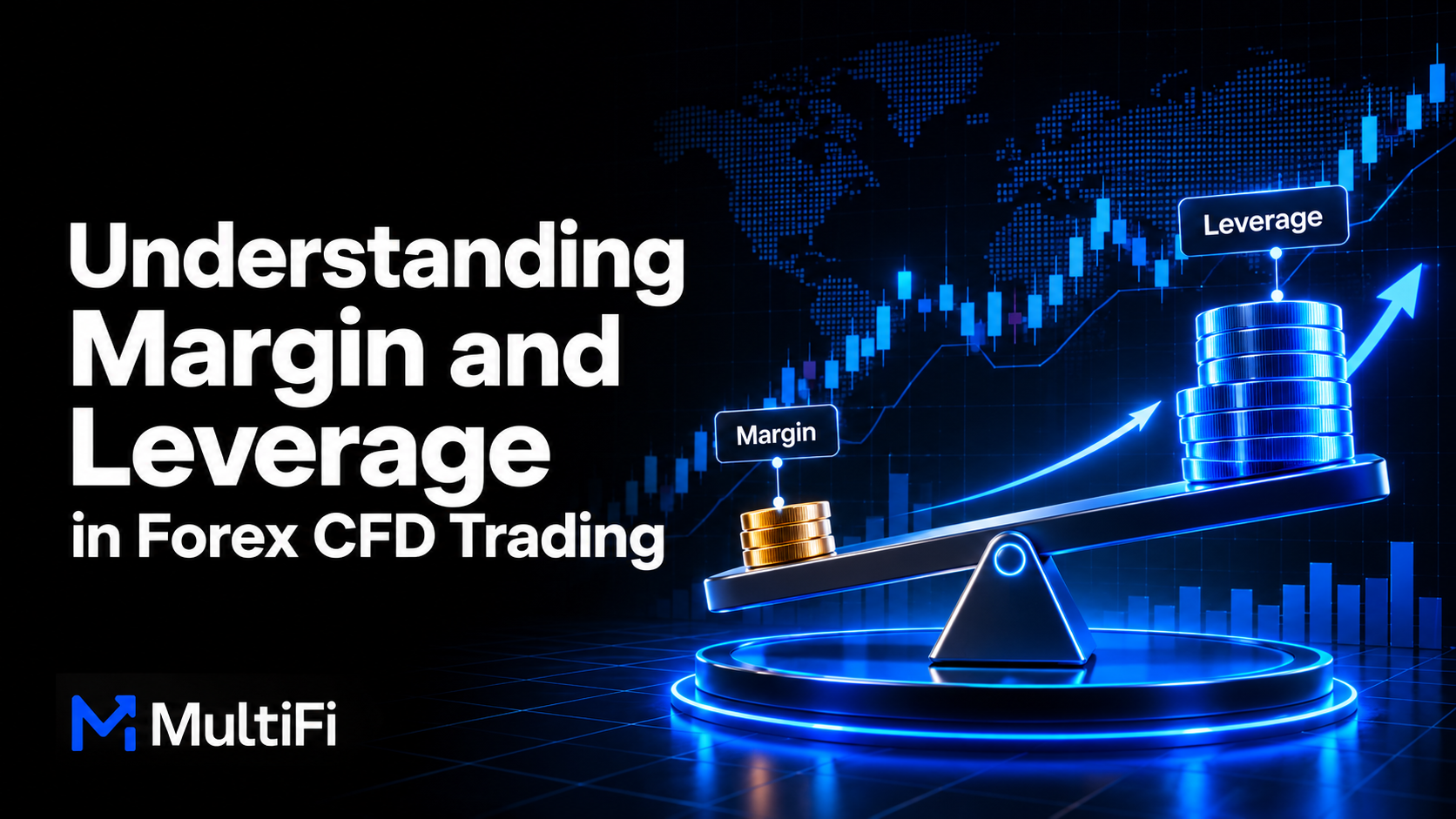
Understanding Margin and Leverage in Forex CFD Trading
MultiFi
22 October 2026
Reading Time - 10 minutes
Many people begin Forex CFD trading by focusing on price predictions, chart patterns and entry signals. Yet even a reasonable market forecast can lead to a substantial loss when a trader does not understand margin, leverage, position exposure and risk.
Offers such as “1:100 leverage” or “control a larger position with less capital” can sound appealing. However, leverage magnifies losses as well as gains. Understanding Margin and Leverage in Forex CFD Trading is therefore an essential part of making informed trading decisions.
For anyone exploring Forex trading in Lebanon, the same principles apply: review the leverage offered for each instrument, understand your broker’s margin and stop-out rules, and check the regulatory terms that apply to your account before trading.
In this guide, we explain the calculations, illustrate how margin affects a position and show how traders can manage leveraged exposure more responsibly.
What Is Leverage in Forex CFD Trading?
Leverage allows you to take exposure to a market position that is larger than the funds you initially commit as margin.
For example, at 1:100 leverage, every $1 of required margin may support $100 of notional exposure, subject to the broker’s contract specifications and margin rules.
If a trade has a $10,000 notional value, its initial margin requirement at 1:100 leverage would be:
Required margin = $10,000 ÷ 100 = $100
Leverage does not make a trading strategy more accurate. It changes how much market exposure you can take relative to your capital.
What Is Margin in Forex CFD Trading?
Margin is the capital set aside to open or maintain a leveraged trading position. It is not the same as a transaction fee, although spreads, commissions, financing charges and other costs may still apply.
Two useful formulas are:
Required margin = Notional position value ÷ Leverage ratio
Required margin = Notional position value × Margin rate
For instance, 1:100 leverage corresponds to an initial margin rate of 1%, where that leverage applies.
Margin requirements can change by instrument, broker and market conditions. A trader should always check the actual requirement shown in their platform rather than relying only on a general example.
Simple Example: How Margin and Leverage Work Together
Assume a trader has an account balance of $1,000 and access to 1:100 leverage.
Theoretical maximum exposure under a simple 1% margin model is:
$1,000 × 100 = $100,000
However, using every available dollar as margin would leave very little room for losses, spreads or other costs. This is a mathematical illustration, not a recommended position size.
Real Forex Example: Buying EUR/USD
Suppose EUR/USD is trading at 1.1600 and a trader buys one standard lot, equal to €100,000.
- Base-currency position: €100,000
- Approximate USD notional value: €100,000 × 1.1600 = $116,000
- Leverage: 1:100
- Approximate required margin: $116,000 ÷ 100 = $1,160
The margin is not $1,000 in this example, because a standard EUR/USD lot is denominated in euros, not dollars. Actual margin can vary based on the broker’s calculation method, account currency and applicable margin schedule.
For this EUR/USD position, one pip is approximately $10. A 50-pip move could therefore produce approximately $500 in profit or loss, before spreads, commissions and other costs.
Why Leverage Feels Attractive—and Why It Can Be Risky
Many major Forex pairs often move by comparatively small percentages in a trading session. Leverage makes these moves more significant relative to the capital committed.
Imagine the EUR/USD position above moves 50 pips:
| Market movement | Approximate P/L on one standard lot |
| +50 pips in the position’s favour | +$500 |
| −50 pips against the position | −$500 |
These outcomes are symmetric before costs. A $500 loss is 50% of a $1,000 account, if the position could be opened and held under the broker’s margin conditions. In fact, at the quoted EUR/USD price and 1:100 leverage, the approximately $1,160 margin requirement would exceed a $1,000 balance, so that particular one-lot position would generally not be available under the simple assumptions above.
The lesson is that leverage and position sizing must be considered together. Available leverage is not a target to use in full.
Available Leverage vs Effective Leverage
A broker might offer 1:100 or higher leverage for an eligible instrument, but this does not mean a trader must use that entire allowance.
Effective leverage = Total notional exposure ÷ Account equity
For example:
- Account equity: $10,000
- Open position exposure: $20,000
- Effective leverage: $20,000 ÷ $10,000 = 2:1
Even if the account has access to a higher maximum leverage ratio, the trader is using just 2:1 effective leverage at that moment. Effective leverage changes as equity and exposure change.
Understanding Used Margin, Free Margin and Equity
A leveraged trading account usually displays several related values:
- Balance: Account funds excluding unrealised gains or losses on open positions.
- Equity: Balance adjusted for unrealised profit or loss and other applicable account adjustments.
- Used margin: Funds committed to support open positions.
- Free margin: Equity minus used margin; the amount generally available to support additional exposure or absorb losses.
For example, if equity is $5,000 and used margin is $1,000:
Free margin = $5,000 − $1,000 = $4,000
Free margin will shrink if open positions lose value. The exact account display and margin mechanics depend on the broker.
What Is Margin Level?
Margin level is a percentage that compares account equity with used margin.
Margin level (%) = (Equity ÷ Used margin) × 100
If equity is $2,000 and used margin is $1,000:
Margin level = ($2,000 ÷ $1,000) × 100 = 200%
A higher margin level generally leaves more room before the broker’s margin thresholds are reached, but 200% is not universally ‘safe’. The specific margin-call and stop-out thresholds vary across brokers, instruments and jurisdictions.
What Is a Margin Call and Stop Out?
A margin call is a broker-defined warning or threshold indicating insufficient margin coverage. Depending on the broker, you may be asked to deposit funds or reduce exposure; some platforms do not issue a separate warning before liquidation.
A stop out occurs when the platform automatically closes some or all positions after the account reaches a specified margin threshold. Closure may happen during fast-moving markets and can crystallise losses.
Before opening any Forex CFD position, identify the broker’s margin-call percentage, stop-out percentage, liquidation policy and negative-balance protections, if any.
Margin and Leverage in Forex CFD Trading: Common Beginner Mistakes
Many avoidable losses are linked to behaviour rather than the trading signal itself:
- Oversized positions: Choosing a lot size based on maximum available margin rather than acceptable loss.
- No predefined exit plan: Entering trades without understanding the financial effect of a stop-loss distance.
- Overtrading: Opening multiple correlated positions that increase total exposure.
- Revenge trading: Increasing size to recover a previous loss quickly.
- Ignoring costs and volatility: Overlooking spreads, slippage, overnight financing and market gaps.
A stop-loss order can help manage risk, but it does not guarantee execution at the requested price in all market conditions.
Gold CFDs: Why Leverage Requires Extra Care
Gold can move sharply around U.S. inflation reports, interest-rate decisions, changes in bond yields and geopolitical events.
A leveraged gold CFD position may therefore experience rapid changes in unrealised profit or loss. Gold contract sizes and margin calculations differ across brokers, so it is misleading to assume every five-lot gold trade has the same exposure.
To assess risk, first check the contract size, the number of ounces represented by each lot, the quoted price, the margin requirement and the approximate loss from a defined price movement.
How Forex Trading in Lebanon Relates to Margin and Leverage
For people considering Forex trading in Lebanon, understanding leverage is only one part of evaluating a Forex CFD service. The broker’s legal entity, applicable regulatory oversight, account terms, available instruments and risk disclosures also matter.
Leverage limits and investor protections are not necessarily the same across all brokers or jurisdictions. A trader based in Lebanon should therefore review which entity would hold the account and what protections, if any, are explicitly available.
U.S. Federal Reserve announcements, ECB decisions, inflation releases and employment reports can all affect internationally traded currency pairs. Traders in Lebanon should monitor these events and account for local time when planning around high-impact releases.
What to Check Before Opening a Forex Trading Account in Lebanon
If you are comparing providers for a Forex Trading Account in Lebanon, consider the following questions before depositing funds:
- Which legal entity operates the trading account, and which regulator, if any, supervises it?
- Which leverage limits apply to the currencies and CFDs you want to trade?
- How are margin, margin-call levels and stop-out levels calculated?
- What spreads, commissions, swap or financing fees and withdrawal charges apply?
- Does the provider offer a demo account, risk controls and clear product specifications?
- What happens during market gaps, and are any negative-balance protections available?
Opening an account should follow appropriate due diligence, not a promise that high leverage creates easy profits.
Practical Risk Management for Leveraged Forex CFDs
A disciplined approach begins with the amount of money you can afford to lose on a trade, not the maximum lot size a platform will permit.
A straightforward planning framework is:
- Decide on a risk budget for the trade relative to account equity.
- Identify a logical exit level based on the strategy and market conditions.
- Calculate the potential loss per unit or pip, including estimated trading costs.
- Choose a position size that fits the risk budget and the broker’s margin requirements.
- Review other open positions for currency or market correlation.
- Check the economic calendar for events that could increase volatility.
Some traders use a 0.5%–2% risk-per-trade rule of thumb, but it is not a guarantee of safety or an appropriate target for everyone. The right approach depends on circumstances, trading experience and the risks of the instrument.
Frequently Asked Questions
1. What is the difference between margin and leverage in Forex CFD trading?
Leverage determines how large an exposure can be relative to the margin requirement. Margin is the capital set aside to support that leveraged position. For instance, a $10,000 position at 1:100 leverage would require approximately $100 of initial margin under a simple 1% margin model.
2. Is higher leverage always more dangerous?
Higher available leverage enables larger positions with less initial margin, which can encourage excess exposure. The risk of a particular trade depends on the position size, market movement, trading costs and risk controls, not just the advertised leverage ratio.
3. What happens when the margin level drops too low?
The account may reach the broker’s margin-call or stop-out threshold. The broker may require action or automatically close positions, according to its terms. These thresholds are not universal.
4. Can beginners use leverage in Forex trading in Lebanon?
Beginners should first understand position sizing, product specifications, margin rules and the possibility of rapid losses. A demo account can help with learning platform mechanics, but simulated trading does not reproduce every live-market condition.
5. What should I check when choosing a Forex Trading Account in Lebanon?
Review the provider’s legal entity and regulatory status, margin and stop-out terms, transaction fees, account funding and withdrawal conditions, product disclosures and available risk-management tools.
6. How much margin is needed to trade one standard lot of EUR/USD?
At EUR/USD 1.1600, one standard lot is €100,000, or about $116,000 in notional value. At 1:100 leverage, the illustrative margin is about $1,160 in a USD-denominated account, subject to broker rules.
7. Can an economic calendar help manage leveraged trades?
Yes. An economic calendar helps traders identify scheduled announcements that may increase volatility. It does not predict price direction or eliminate the risk of gaps, slippage or losses.
Final Thoughts
Margin and Leverage in Forex CFD Trading are tools for managing market exposure; they are not shortcuts to consistent profits. Leverage can make a modest price movement produce a large change in account equity, especially when position sizes are too large.
Whether you are learning the basics or assessing Forex trading in Lebanon, focus on understanding how margin is calculated, tracking your account equity, setting realistic risk limits and reviewing your broker’s terms.
Risk disclaimer: Forex and CFD trading involve substantial risk, particularly when leverage is used. Losses can occur rapidly. This material is for general education and is not personalised financial or legal advice.
In this article