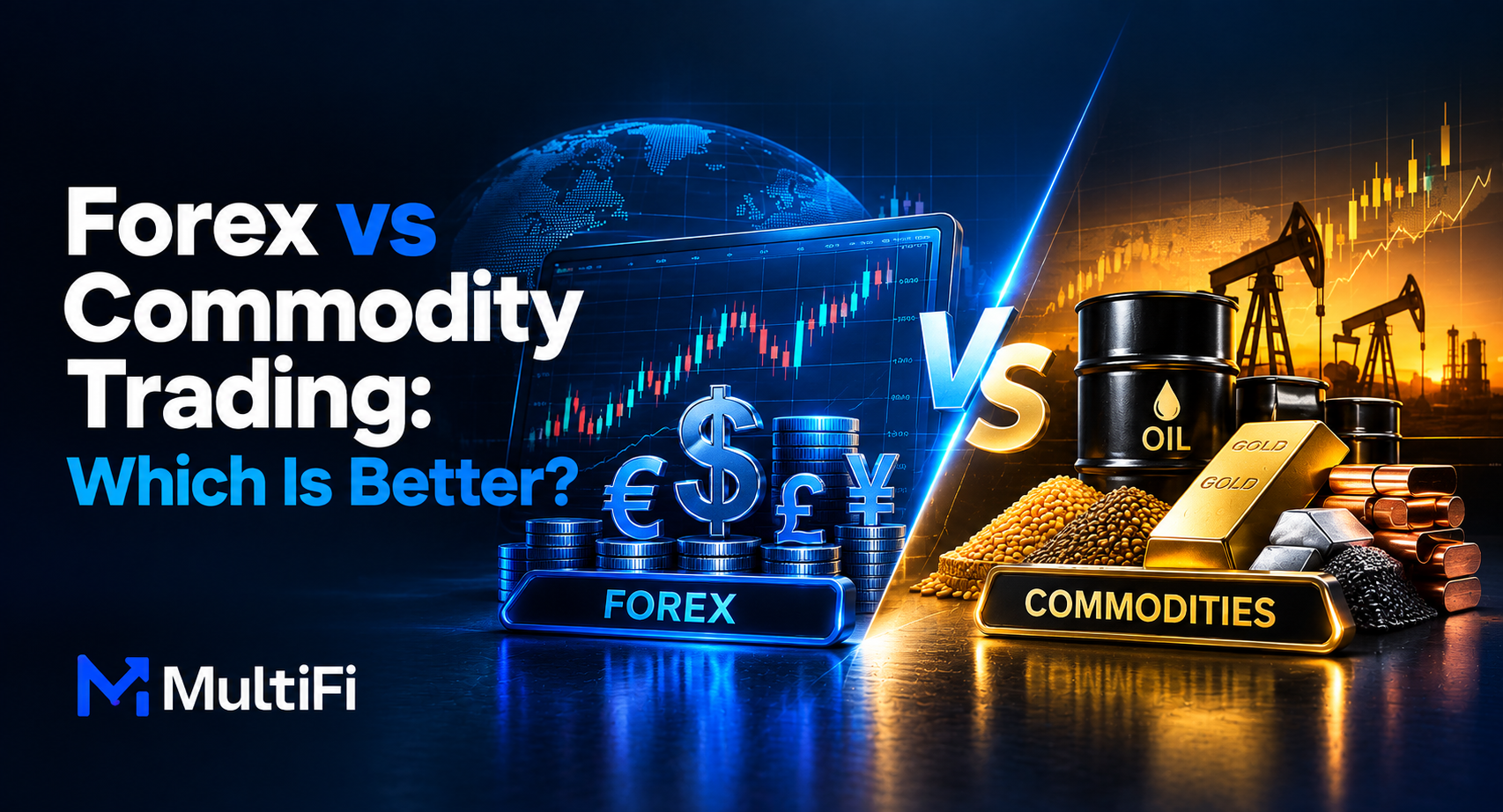
Forex vs Commodity Trading: Which Is Better?
MultiFi
29 September 2026
Reading Time - 8 minutes
You’ve decided to start trading online. Now comes the big question: should you trade currencies or commodities like gold and oil?
Ask ten traders and you’ll hear ten confident answers. The honest answer is that neither is “better” for everyone. It depends on your goals, schedule and how much risk you’re comfortable with.
This guide breaks down forex vs commodity trading in plain language, so you can choose based on facts, not hype.
Forex or Commodities?
- Choose forex if you want long trading hours, tight spreads and a wide choice of currency pairs.
- Choose commodities if you follow global news, enjoy trading gold or oil, and can handle bigger swings.
- Beginners often start with major forex pairs or gold on a demo account.
- Both need strict forex risk management, whichever you pick.
What Is Forex Trading?
Forex (foreign exchange) means trading one currency against another, such as EUR/USD or GBP/USD. You’re betting on whether one currency will strengthen or weaken against the other.
It’s the largest financial market in the world, with trading running around the clock from Monday to Friday. That size means high liquidity, so you can usually enter and exit trades quickly.
What Is Commodity Trading?
Commodities are raw materials. They include metals (gold, silver), energy (crude oil, natural gas) and agricultural products (wheat, coffee).
Most online retail traders don’t buy barrels of oil. They trade CFDs, which track price movements without owning the physical goods. Prices react to supply, demand, weather, politics and economic data.
How Each Market Works
Forex
Currencies are quoted in pairs. If EUR/USD rises, the euro is getting stronger against the dollar. You profit by correctly predicting direction, measured in pips, the small price steps in currency markets.
Commodities
Prices move on real-world events. An OPEC production decision moves oil. Inflation fears and geopolitical tension often move gold. Weather can move crops. Traders read news more closely here.
Forex vs Commodity Trading: Side-by-Side Comparison
| Factor | Forex | Commodities |
|---|---|---|
| What you trade | Currency pairs | Gold, oil, gas, crops |
| Market hours | Nearly 24 hours, 5 days | Varies by product |
| Liquidity | Very high on major pairs | High for gold and oil, lower for others |
| Volatility | Moderate for majors | Often higher and news-driven |
| Typical costs | Tight spreads on majors | Wider spreads, possible overnight fees |
| Main drivers | Interest rates, economy | Supply, demand, geopolitics |
| Beginner friendliness | Good | Good for gold, tougher for others |
Benefits of Forex Trading
- Flexible hours. Trade before or after work.
- Low entry cost. Many brokers allow small deposits.
- Deep liquidity. Major pairs are easy to trade.
- Two-way opportunity. You can profit from rising or falling prices.
- Plenty of learning material. Beginners find more guides and tools.
Benefits of Commodity Trading
- Diversification. Commodities don’t always move with currencies or stocks.
- Inflation hedge. Gold has traditionally attracted investors during uncertainty.
- Tangible link to real events. Some traders find news-based trading easier to understand.
- Strong trends. Energy and metals can move in clear directions.
Risks You Must Understand
Forex Risks
- Leverage magnifies losses as much as gains.
- Overtrading is common because the market never seems to close.
- Central bank surprises can move prices within seconds.
Commodity Risks
- Sudden spikes. A supply disruption can move prices sharply.
- Wider spreads in less popular markets.
- Overnight costs on leveraged positions held for days.
- Event risk. Reports, weather and politics create gaps.
Both markets can produce losses greater than beginners expect. That’s why forex risk management matters more than picking the “right” market.
Step-by-Step: How to Choose the Right Market for You
- Define your goal. Are you seeking side income, long-term growth or learning a new skill?
- Check your schedule. Forex suits early morning and evening sessions. Commodities like oil react strongly around news releases.
- Assess your risk tolerance. If large swings make you anxious, start with major forex pairs.
- Open a demo account. Trade both for at least a month.
- Track your results. Note which market you understand and manage better.
- Start small on a live account. Add capital only after consistent demo results.
- Review monthly. Adjust your plan as you learn.
Simple Forex Risk Management Rules For Both Markets
- Risk 1-2% of your account per trade. A string of losses won’t wipe you out.
- Always use a stop-loss. Decide your exit before entering.
- Keep leverage modest. Higher leverage isn’t a gift, it’s a lever on your mistakes.
- Watch the economic calendar. Avoid entering right before major announcements unless it’s part of a tested plan.
- Keep a trading journal. Record your reasons, results and emotions.
- Never trade money you need. Rent and food money stay out of the market.
A Practical Example
Say you have $1,000 and risk 1% per trade, which is $10.
On a forex trade, you set a stop-loss 20 pips away, so each pip is worth around $0.50. On a gold trade, you might set a wider stop because gold typically moves more. To keep the risk at $10, you’d reduce the position size.
Same risk, different position size. That’s risk management in action, and it shows why the market matters less than your discipline.
Why Forex vs Commodity Trading Isn’t Either-Or
Many experienced traders don’t see forex vs commodity trading as a fight. They treat the markets as tools. A trader might use currency pairs during the London session, then watch gold when US inflation data lands.
The skill that carries across both is the same: a clear plan, controlled risk and patience. Learn that first, and switching markets becomes much easier.
Choosing a Broker For Either Market
Whichever market you choose, your broker matters as much as your strategy. If you’re looking for a forex broker in Lebanon, check:
- Regulation. Verify the licence on the regulator’s official website (see our regulation guide).
- Costs. Compare spreads, commissions and overnight fees on both currencies and commodities.
- Platform. It should work smoothly on mobile and desktop.
- Product range. You want forex and commodities on one account.
- Withdrawals. Test with a small amount early.
- Support. Look for responsive, clear communication.
You’ll see lists naming the best forex broker in Lebanon. Use them as a starting point, then do your own checking. The best broker is the one that suits your style and can be verified.
Which Is Better For Forex Trading in Lebanon?
For most beginners interested in forex trading in Lebanon, major currency pairs are a practical starting point. Costs are low and learning resources are plentiful. If you already follow gold or oil news closely, commodities may feel more natural.
The smartest approach is often to learn one market well, then add the other later. Trying both at once on day one usually creates confusion.
Conclusion
Forex and commodities are both legitimate markets with real opportunities and real risks. Forex offers accessibility and long hours. Commodities offer diversification and strong, news-driven moves.
The winner in forex vs commodity trading is the one that fits your goals, schedule and risk comfort. Try both on a demo account, protect your capital with firm risk rules, and choose a properly regulated broker.
Ready to explore both markets? Open a free Multifi.trade demo account and compare forex and commodity trading side by side before you risk real money.
Risk warning: Forex and CFD trading carries a high risk of loss and may not be suitable for everyone. This article is educational and not financial advice.
Frequently Asked Questions
1. Is forex or commodity trading better for beginners?
Major forex pairs are often easier to start with because of tight spreads, high liquidity and plentiful learning material. Gold can also work well for beginners. Whichever you pick, practise on a demo account first and limit risk to a small percentage of your balance per trade.
2. Which is more volatile, forex or commodities?
Commodities such as oil and natural gas are generally more volatile than major currency pairs, because supply shocks and news events can move prices sharply. Forex can still move fast around central bank decisions. Volatility creates both opportunity and risk, so position sizing matters.
3. Can I trade forex and commodities with the same broker?
Yes, many brokers offer currencies, metals, energy and indices on a single platform, usually through CFDs. Compare costs, leverage limits and regulation before choosing. Also confirm whether overnight fees apply to commodity positions you hold for more than a day.
4. How much money do I need to start trading?
Some brokers accept deposits from around $10 to $100, but a very small account limits proper risk management. Start with an amount you can afford to lose and use a demo account first. Never use money needed for daily living expenses.
5. Do the same risk management rules apply to commodities?
Yes. Use stop-losses, risk only 1-2% per trade, keep leverage modest and avoid trading during major announcements without a plan. Commodities may need wider stops because of larger price swings, so reduce position size to keep your overall risk the same.
In this article