
What Are the Factors Affecting Forex Exchange Rates?
MultiFi
19 October 2026
Reading Time - 12 minutes
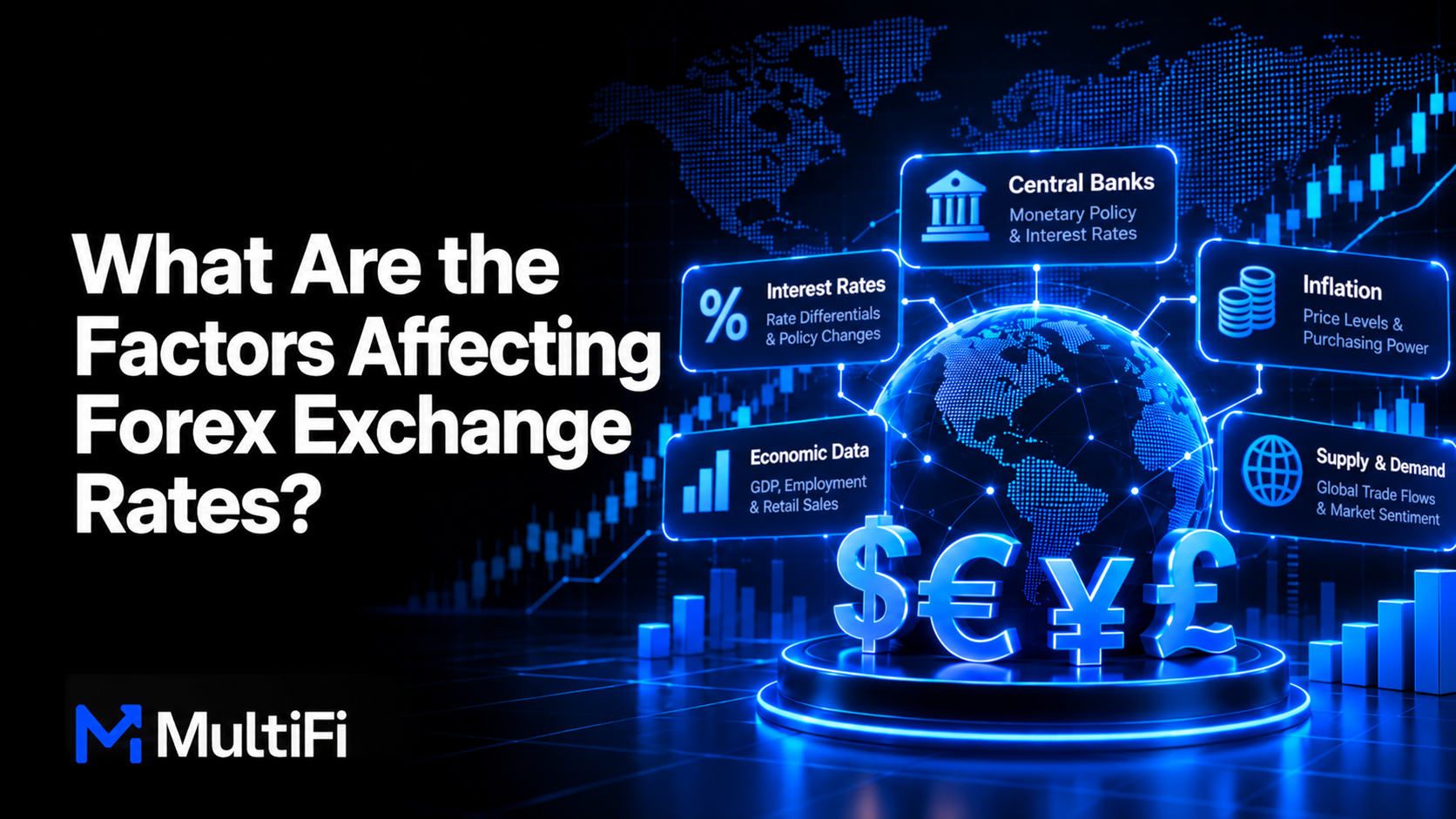
Forex is not just about chart patterns. For those exploring Forex trading in Lebanon, understanding what moves exchange rates is essential before making trading decisions. Global economic news, central bank policy and currency demand can influence major pairs, even when the news originates far beyond Lebanon.
A currency pair is the live scorecard of two economies fighting against each other every second.
When you trade EUR/USD, GBP/USD, USD/JPY, AUD/USD or USD/INR, you are not simply trading a line on a screen. You are trading:
- interest rates
- inflation
- growth
- oil prices
- capital flows
- government credibility
- central bank policy
- market fear
- global liquidity
The Forex market is also huge. Global FX turnover reached about $9.6 trillion per day in April 2025, according to BIS data, which shows how deeply currencies are connected to trade, investment, hedging and speculation.
Why Exchange Rates Matter for Forex Trading in Lebanon
Traders based in Lebanon can follow global currency pairs such as EUR/USD, GBP/USD and USD/JPY. These pairs respond to international monetary policy, economic releases and shifts in investor sentiment. Lebanon’s own economic environment can also affect how individuals think about currency exposure, but the market price of a global pair is not determined by Lebanese conditions alone.
For anyone considering a Forex Trading Account in Lebanon, understanding exchange-rate drivers is only part of the preparation. It is also important to check whether a provider accepts residents of Lebanon, its applicable regulatory status, trading costs, leverage terms and withdrawal conditions. Access to an account does not eliminate the risk of leveraged trading.
1. Interest Rates: The Biggest Currency Driver
The most powerful driver of exchange rates is usually the interest-rate difference between two countries.
Simple logic:
If U.S. rates are high and Eurozone rates are low, global money may prefer dollars.
Why?
Because investors can earn better returns holding dollar assets.
Example:
If the Fed is expected to keep rates high while the ECB may cut rates, EUR/USD can come under pressure.
Retail traders often ask:
“Why is EUR/USD falling even after bad U.S. data?”
Because markets may still believe U.S. rates will remain higher than European rates.
Forex does not move only on today’s data.
It moves on future expectations.
2. Inflation: The Silent Currency Killer
Inflation affects currencies in two opposite ways.
High inflation can initially support a currency if markets expect the central bank to raise interest rates.
But if inflation becomes uncontrolled, it weakens the currency because purchasing power falls.
Example:
If oil prices rise sharply, Europe faces higher import costs because it is a net energy importer. That can hurt growth, raise inflation and make the ECB’s job harder. Recent EU forecasts warned that energy shocks from Middle East tensions could slow eurozone growth and lift inflation above the ECB’s target.
For EUR/USD traders, this matters deeply.
Higher oil can mean:
- weaker Eurozone trade balance
- weaker growth
- higher inflation
- more policy confusion
- possible EUR weakness against USD
3. Economic Growth: Strong Economies Attract Capital
Currencies usually like strong growth.
If an economy is growing well:
- companies earn more
- jobs improve
- investors buy local assets
- foreign capital enters
- currency demand rises
Example:
If U.S. GDP remains resilient while Europe slows, EUR/USD may fall even if both regions have inflation.
Why?
Because capital prefers stronger growth with better returns.
Retail trader lesson:
Do not look at inflation alone.
Always ask:
“Is this inflation coming with growth, or without growth?”
Inflation with growth can support a currency.
Inflation with recession risk can damage it.
4. Current Account and Trade Balance
A country that exports more than it imports usually receives foreign currency inflows.
A country that imports more than it exports needs foreign currency to pay bills.
This matters especially for oil importers.
Example:
If crude oil rises from $80 to $110:
- Japan pays more dollars for oil
- Europe pays more dollars for oil
- India pays more dollars for oil
- trade deficits can widen
- local currencies may weaken
This is why oil shocks often pressure currencies of net energy importers.
Reuters recently noted that Asian currencies were showing stress from the oil shock, especially in energy-dependent economies.
How to Follow Events with a Lebanon Economic Calendar
A Lebanon Economic Calendar can help traders organise upcoming data releases in their local time, including U.S. inflation, Non-Farm Payrolls, Federal Reserve decisions, ECB meetings and GDP reports. Look at the previous, forecast and actual figures to understand whether an announcement surprised the market.
For Forex trading in Lebanon, check that the calendar uses the correct Beirut time setting, including any seasonal time changes. Note high-impact events before opening a position, as liquidity, spreads and execution prices can change sharply around news releases. A calendar highlights potential volatility; it does not predict direction.
5. Central Bank Communication
Sometimes the central bank does not even need to change rates.
Words alone can move Forex.
These words matter:
- “higher for longer”
- “inflation remains sticky”
- “policy needs to stay restrictive”
- “growth risks are rising”
- “rate cuts may be delayed”
Example:
If the Fed says inflation is still too high, USD may strengthen.
If the ECB says growth risks are increasing, EUR may weaken.
Retail trader mistake:
They wait only for rate decisions.
Professional traders watch:
- speeches
- meeting minutes
- voting patterns
- inflation language
- forward guidance
6. Bond Yields: The Hidden Engine Behind Forex
Currencies often follow bond yields.
If U.S. Treasury yields rise faster than German yields, EUR/USD may fall.
If Japanese yields rise while U.S. yields fall, USD/JPY may decline.
Bond yields show where global capital may earn better returns.
Simple example:
If U.S. 10-year yield rises sharply, global investors may buy U.S. bonds.
To buy U.S. bonds, they need dollars.
So USD demand rises.
That is why bond markets often move before Forex traders understand the reason.
7. Risk Sentiment: Fear Strengthens Safe-Haven Currencies
During global fear, markets often buy:
- USD
- CHF
- sometimes JPY
During confidence, markets often buy:
- AUD
- NZD
- emerging market currencies
- high-yield currencies
Example:
If war risk rises in the Middle East:
- oil rises
- equities fall
- investors reduce risk
- USD and CHF may strengthen
- AUD/NZD may weaken
This is not because the chart suddenly changed.
It is because global investors are reducing risk.
8. Commodity Prices
Some currencies are highly linked to commodities.
Examples:
- CAD linked to oil
- NOK linked to oil and gas
- AUD linked to iron ore and China demand
- NZD linked to dairy and global risk appetite
If oil rises, CAD may benefit because Canada is an oil exporter.
But if oil rises because of global war risk, USD may still outperform CAD due to safe-haven demand.
This is important.
One factor never works alone.
Context decides the reaction.
9. Political Stability and Fiscal Discipline
Currencies dislike uncertainty.
If a country has:
- political instability
- high debt
- weak governance
- large deficits
- policy confusion
then investors demand a higher risk premium.
That can weaken the currency.
Example:
If a government increases spending aggressively while inflation is already high, bond yields may rise.
But the currency may not strengthen if investors believe the fiscal path is unsustainable.
This is why high yields alone are not always bullish.
Sometimes high yields mean opportunity.
Sometimes high yields mean danger.
10. Capital Flows: The Real Money Behind FX Moves
Currencies move when capital moves.
Capital flows include:
- foreign direct investment
- equity inflows
- bond inflows
- hedge fund positioning
- corporate hedging
- central bank reserve management
Example:
If global funds sell European equities and buy U.S. tech stocks, they may sell EUR and buy USD.
This can weaken EUR/USD even if economic data is mixed.
Retail traders focus on candles.
Professional traders ask:
“Where is global money flowing?”
11. Geopolitics and War Risk
Geopolitics can override normal economic logic.
During conflict:
- oil can spike
- shipping costs rise
- inflation expectations rise
- capital moves to safe havens
- emerging market currencies weaken
- central banks become cautious
The current Middle East conflict has already triggered concern over energy prices, eurozone growth and inflation. AP reported that the EU lowered its eurozone growth outlook while expecting inflation to rise because of the energy shock.
For retail traders, the lesson is simple:
During war-driven markets, technical levels can break violently.
Risk management becomes more important than prediction.
12. Market Positioning
Sometimes a currency moves opposite to the news.
Why?
Because the market was already positioned heavily one way.
Example:
If everyone is already long USD, even good U.S. data may not push USD higher.
Why?
Because the buying has already happened.
This is called “priced in.”
Retail traders ask:
“Why did the dollar fall after strong data?”
The answer may be:
Because the market expected even stronger data.
Forex moves on surprise, not just absolute numbers.
13. Central Bank Intervention
Some currencies are actively managed.
Central banks may intervene to slow excessive moves.
They can:
- sell dollars
- buy local currency
- use reserves
- guide state banks
- change liquidity rules
- raise rates suddenly
This is common in emerging markets.
But intervention usually works best when it supports fundamentals.
If fundamentals are weak, intervention may only slow the move, not reverse it.
14. Real-Time Example: EUR/USD and Oil Shock
Let’s take a practical EUR/USD example.
Suppose:
- Brent crude rises above $100
- Eurozone inflation rises
- German manufacturing weakens
- ECB faces growth risk
- U.S. dollar gains safe-haven demand
Now EUR/USD may fall.
Not because of one reason.
Because multiple forces align:
- Europe is hurt by energy imports
- USD benefits from safe-haven flows
- U.S. yields may stay supported
- global risk sentiment weakens
This is a macro cluster.
Retail traders should always look for clusters, not single signals.
15. Real-Time Example: USD/JPY and Yield Gap
USD/JPY is heavily sensitive to interest-rate differences.
If U.S. yields rise and Japanese yields remain lower, USD/JPY can rise.
But if markets believe Japan may tighten policy or intervene, USD/JPY can suddenly reverse.
This pair teaches one big lesson:
Trend can continue for months, but policy risk can change the game overnight.
16. Real-Time Example: AUD/USD and China
AUD/USD is not only about Australia.
It is also a China proxy.
Why?
Because Australia exports large amounts of commodities to China.
If China demand improves:
- iron ore demand rises
- Australian exports improve
- AUD may strengthen
If China slows:
- commodity demand weakens
- AUD may fall
So AUD/USD traders must watch:
- China PMI
- iron ore prices
- risk sentiment
- RBA policy
- U.S. dollar trend
17. The Deepest Truth: Forex Is Relative
This is the most important concept.
A currency does not need to be strong in absolute terms.
It only needs to be stronger than the other currency in the pair.
EUR/USD falls when USD is stronger than EUR.
GBP/USD rises when GBP is stronger than USD.
USD/JPY rises when USD is stronger than JPY.
So every Forex trade is a comparison.
You are always asking:
“Which economy, central bank, yield structure and capital flow is stronger right now?”
Applying the Factors to a Forex Trading Account in Lebanon
When using a Forex Trading Account in Lebanon, the same global macro factors apply to trades in internationally traded currency pairs. Before placing an order, compare central bank expectations, review upcoming events and consider whether the potential loss fits your risk tolerance. Check the provider’s costs and local eligibility rather than assuming every international platform offers the same terms to Lebanese residents.
A useful daily habit is to open your Lebanon Economic Calendar alongside your charts, identify high-impact announcements and review how the relevant currency pair has reacted to similar events in the past. Past market reactions are informative but do not guarantee future outcomes.
Frequently Asked Questions
1. What factors affect exchange rates in Forex trading in Lebanon?
The main influences include interest-rate expectations, inflation, economic growth, trade balances, bond yields, capital flows, political risk and overall market sentiment. Lebanese traders following global currency pairs face the same international price drivers as traders elsewhere.
2. What is a Lebanon Economic Calendar used for?
A Lebanon Economic Calendar helps traders track scheduled economic announcements in Beirut local time. It can flag high-impact news such as U.S. CPI, employment reports and central bank rate decisions, allowing traders to plan around possible volatility.
3. What should I check before opening a Forex Trading Account in Lebanon?
Check whether the broker accepts Lebanese residents, what regulatory protections apply, and the details of spreads, commissions, leverage, deposits and withdrawals. Make sure you understand the risks, particularly the possibility of rapid losses with leverage.
4. Can an economic calendar predict which way a currency pair will move?
No. Even when a data release surprises the market, prices may react differently depending on expectations, existing positions and broader financial conditions. The calendar is a planning aid, not a trading signal.
Final Thought
Forex exchange rates are affected by many factors, but they do not work separately.
They work like a chain.
- Oil affects inflation.
- Inflation affects central banks.
- Central banks affect bond yields.
- Bond yields affect capital flows.
- Capital flows affect currencies.
- Currencies affect inflation again.
That is the circular nature of Forex.
Retail traders often lose money because they search for one perfect indicator.
But Forex is not a one-indicator market.
It is a global macro story written every day through interest rates, inflation, trade, politics, energy and investor psychology.
The trader who understands this does not just ask:
“Should I buy or sell?”
They ask:
“What is the macro reason behind this move, and is the market already pricing it?”
That is where real Forex thinking begins.
In this article